


Is it too late to learn AI in 2026? No. Learn what to focus on first, what to ignore, and how to build useful skill without trying to catch every launch.
Here is the short answer. No. It is not too late to learn AI in 2026.
It is too late to learn AI by trying to memorize every model, framework, benchmark, course, and product launch. Nobody can keep up with all of that. The people making progress are not the people who know every name. They are the people who can use the tools, check the result, and keep learning when the interface changes.
I know the question because I have asked a version of it myself. I did not come into AI through computer science. I started with practical work, then kept pulling on the thread until I was building things I never expected to build.
The path has been uneven. Work, family, taxi shifts, bills, broken momentum, and long stretches where I felt behind all came with it. I still kept learning. That is the point of this article. You do not need a perfect start. You need a start you can repeat.
Quick answer
Is it too late to learn AI in 2026?
No. It is not too late to learn AI in 2026. Start with one real task, learn the few terms that explain it, practice with one or two tools, and turn one useful result into a repeatable workflow. Learning to use AI, build small AI-assisted workflows, and engineer production systems are different goals. Choose the level that matches the work you actually want to do.
If you want the practical sequence after this confidence check, read How to Start Learning AI in 2026. If you are worried that coding is the entrance exam, read Do You Need to Know How to Code to Use AI?.
Quick Start
What to do first
Pick one real outcome. Choose a task you already need to finish, such as an email, summary, study plan, research brief, or small business workflow.
Use one tool first. Give yourself enough repetitions to learn what one general AI assistant can and cannot do before collecting more tools.
Learn vocabulary as it appears. Keep the ACC glossary nearby and learn the terms that unlock the task in front of you. You do not need the whole dictionary on day one.
Review every result. Check facts, links, calculations, privacy, and tone. Using AI is not the same as turning your judgment off.
Repeat the useful part. Save the prompt or workflow that helped, improve it, and use it again with a different input next week.
You did not miss the boat. You missed some of the hype.
Some people started experimenting with AI before you did. That is true. They may have learned a few tools earlier, built an audience earlier, or caught a product opportunity when fewer people were paying attention.
That does not mean they own the future, and it does not mean you are disqualified. AI is still changing quickly. The names, interfaces, prices, and popular workflows keep moving. There is no final exam where everyone who started first gets a permanent certificate and everyone else is locked out.
The bigger danger is believing that you need to catch up on the entire history of AI before you are allowed to use it. You do not. You need to learn enough to solve the next real problem in front of you.
That is a much smaller job. It is also a more useful one.
The old comparison is wrong
You are not competing with somebody who has watched more launch videos. You are trying to make a useful task easier, faster, or clearer.
The finish line keeps moving
Even experienced builders are constantly learning new tools. The durable skill is knowing how to learn the next tool without starting from zero.
Your first win can be small
A better weekly plan, a cleaner email, a verified research summary, or one boring task turned into a repeatable workflow counts as real progress.
The useful number
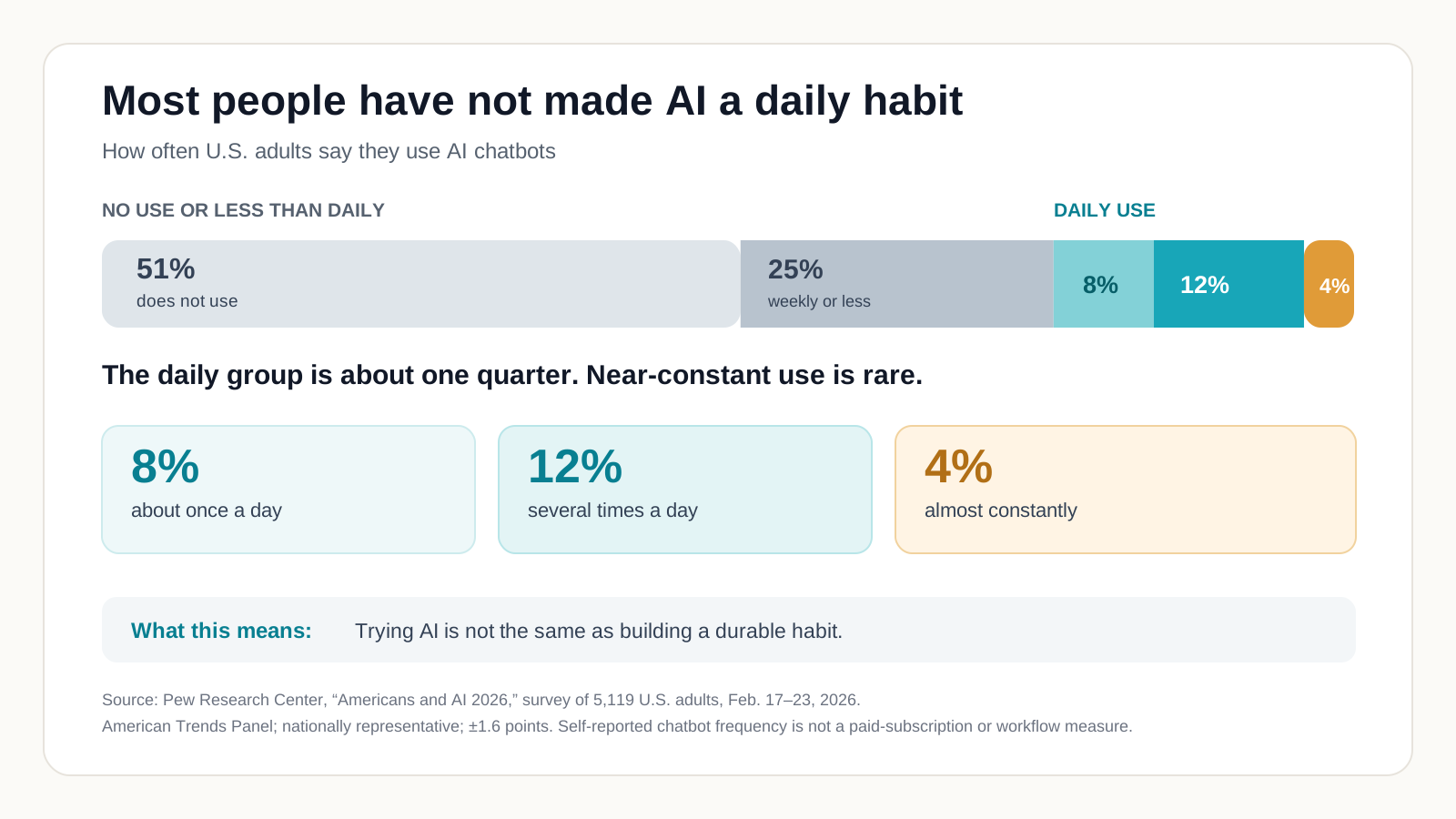
Most people have not made AI a daily habit
A Pew Research Center survey of 5,119 U.S. adults, conducted February 17–23, 2026, gives a much more useful answer to the “am I late?” question. It measures how often people say they use AI chatbots, not whether they have heard of AI or tried one once.
The frequency breakdown: 8% use chatbots about once a day, 12% use them several times a day, and 4% use them almost constantly. That adds up to about 24% using chatbots daily. Another 25% use them several times a week or less, while 51% do not use chatbots at all.
That is not a paid-subscription or verified workflow measure. It is still the relevant signal here: trying AI is spreading, but making it a daily habit is not the default. There is room to learn the useful part without pretending you missed the only window.
What are you actually trying to learn?
A lot of beginners feel late because the word AI hides several different jobs. Using an assistant is one job. Building an app is another. Designing a reliable production system is another one entirely.
Online conversations often jump straight to the hardest layer. Somebody shows a code editor, an agent swarm, or a research paper, and the beginner assumes that is the starting line. It is not. Start at the layer that matches the result you want.
| Layer | What you are doing | What to learn first |
|---|---|---|
| Use | Ask an AI assistant to write, explain, summarize, plan, or organize | Clear instructions, context, and review |
| Workflow | Connect a few repeatable steps around a task | Inputs, outputs, permissions, and failure checks |
| Build | Create a custom website, app, agent, or internal tool | Problem definition, basic code reading, testing, and iteration |
| Engineer | Run a dependable system that other people or important data rely on | Code, security, monitoring, data handling, and recovery plans |
My experience
My path was late, uneven, and useful
I did not enter AI through a traditional developer path. I started by using tools like Copy.ai to help with client copy and practical work. The task made sense to me even when the technology was new.
Then I opened tools like Cursor because everybody was talking about AI-assisted coding. It felt powerful, but it also felt like I had walked into a room built for developers. I did not understand every error, every folder, or every decision the tool was making. That part was humbling.
I also made the classic beginner mistake of asking for too much at once. I asked AI to build a complete DeFi app that traded, staked, lent, and swapped in one shot. It came back half-built. My first reaction was to blame the tool. The better lesson was that I had described a dream instead of one clear task. One task. Test it. Then build the next piece.
I kept going by working on real projects. I watched videos, read about tools, took Google AI courses, and completed a Claude 101 course. I learned enough to use the next tool, then enough to understand the next problem. I did not wait until I felt ready because ready kept moving.
The projects gave the learning somewhere to land. ACC Network became a site, newsletter, and editorial system. Prep2Eat moved from an idea toward a real app I could test. Users were confused by parts of it, so I changed the interface, recipe placement, grocery-list flow, mascot states, and error handling. That was AI learning in real life: notice friction, describe the problem, test the fix, and repeat.
I built the Marketing Agent OS, smaller research agents, and the Trading Army while working, raising a family, and doing taxi shifts.
There were breaks. There were slow weeks. There were days when I started late and still had to decide whether a small amount of progress was worth it. It was. A messy learning path is still a learning path if you return to it.
Later, the same learning loop helped me improve the ACC newsletter workflow. A first source scan that used to take roughly 45 to 60 minutes took about four minutes in a practice run, while story selection, sending, and social publishing stayed under human approval. The bigger workflow came later. It started with learning how to use AI on practical work.
I am not claiming AI turned me into an expert programmer overnight. It helped me learn how to describe a problem, break work into smaller pieces, test what came back, and ask better questions when the output was wrong. That is a real skill, and it keeps paying off.
The beginner advantage people underestimate
Beginners often assume experience means knowing more product names. It does not. A useful AI learner also needs a real problem, enough judgment to spot a bad answer, and the patience to improve a process instead of chasing a shiny demo.
If you already know your work, your customers, your class, your family schedule, or the project you are trying to build, you already have context that a general AI tutorial cannot give you. Use that context.
You know what a good result looks like
A subject-matter beginner may be new to AI but still understand whether an email sounds wrong, a budget is unrealistic, or a customer answer misses the point.
You can start with a real workflow
The best first project is usually a task you repeat, not a random demo chosen because it looked impressive online.
You can learn in layers
Start with use, add workflow thinking, then learn code or deeper technical ideas when the work gives you a reason.
You can bring human judgment
AI can generate options quickly. You still decide what is accurate, safe, useful, and worth shipping.
What to learn first in 2026
You do not need a giant curriculum to begin. You need a short list of skills that transfer across tools. Product names will change. These habits will still matter.
Basic AI vocabulary
Learn what a model, prompt, context window, token, hallucination, agent, and API mean in normal language. The ACC glossary is there for exactly this.
Clear instructions
Tell the tool what you want, who it is for, what source material it can use, and what a good answer should look like. The guide to better prompts gives you a simple template.
Verification
Check names, dates, links, calculations, assumptions, and missing context. A confident answer is not the same as a correct one.
Privacy and permissions
Know what data you are pasting into a tool and what access a workflow or agent has. Do not hand broad permissions to an experiment just because the setup was easy.
Small workflow design
Define the trigger, input, steps, output, and approval point for one recurring task before you try to automate your whole life.
Source filtering
Follow fewer, better sources. Learning AI is easier when your information diet gives you a signal instead of another stream of launches to feel guilty about missing.
Try this this week
A small proof beats a giant learning plan
You do not need to disappear for a month and return as an AI expert. You need one visible proof that using AI helped with a real task. That proof might be a cleaner draft, a research brief with checked sources, a better weekly plan, or a small workflow you can repeat.
Give yourself a small block this week. Use more time when you have it, but do not make perfect study conditions a requirement. The point is to move from watching other people use AI to using it yourself.
Choose one weekly task
Pick something real and repeatable instead of collecting tutorials.
Create one visible result
Finish a draft, cleaner process, small automation, or research brief someone can inspect.
Review what came back
Check the facts, sources, assumptions, privacy, and usefulness before you keep the workflow.
Learn the next concept only when needed
Let the real blocker choose the next lesson. Do not study the whole field in advance.
Do you need to learn coding?
Not to start using AI. You can learn the basic concepts, improve everyday work, study a topic, and build simple workflows without becoming a programmer first.
Coding becomes more useful when you need a custom feature, several systems to work together, dependable error handling, stronger security, or a product that other people rely on. That is not a reason to wait. It is a reason to learn the next technical piece when your project asks for it.
The mistake is treating code as either a wall you can never climb or a badge you must earn before touching AI. It is a tool. Learn enough to solve the next problem, then keep going.
Start without code
Use AI for writing, research, explanations, planning, summaries, and small repeatable tasks.
Add technical skills when needed
Learn basic code reading, APIs, data formats, and debugging when a ready-made tool stops giving you the result you need.
Keep review in the loop
AI-assisted building can move quickly, but tests and human judgment still matter when the work affects customers, money, privacy, or a live system.
The traps that make people feel late
Most people do not quit because AI is impossible. They quit because they turn learning into a comparison game. Then every new post becomes evidence that somebody else is further ahead.
Watching instead of doing
Ten videos about prompts do not replace using one prompt on a real task. Information can become procrastination dressed up as research.
Collecting tools
A folder full of AI apps does not prove you can use any of them. Start with one tool and one outcome.
Paying to calm anxiety
Do not buy every subscription or course because the sales page made you feel behind. Upgrade when a real limit blocks a workflow.
Trying to build too much
Your first project does not need to be a startup, an agent swarm, or a full platform. Make one useful thing work.
Waiting for a perfect path
The path will become clearer after you use the tools. You are allowed to start with a small question instead of a five-year plan.
How you know you are making progress
You are not done learning AI when you know every term. You are making progress when the tools create better decisions and less friction in real work.
You can explain one AI concept in plain English
The topic is becoming usable instead of mysterious.
You give clearer instructions
You are learning how context and constraints change the result.
You catch a weak or invented answer
Your judgment is improving along with your tool fluency.
You repeat a task with less friction
The learning is turning into a workflow instead of staying theoretical.
You know what to learn next
You are following the needs of your work instead of chasing the whole field.
The honest bottom line
You are not too late. You are early enough to build a useful habit and late enough to avoid some of the nonsense that made the first wave so noisy.
Do not make learning AI another identity project. Pick a real task. Learn the part you need. Check the result. Keep the useful piece. Then do it again.
That is how I have made progress while working, raising a family, building projects, and dealing with plenty of weeks where the schedule fell apart. Not by catching up with everything. By returning to the next useful problem.
If you want a practical place to continue, use the four-week roadmap in our guide to starting AI. If you want a calmer stream of what is worth your next few minutes, subscribe to the ACC Network daily signal.
FAQ
Is it too late to start learning AI in 2026?
No. It is not too late. Start with one real task, one AI tool, and a simple habit of reviewing and improving the result. You do not need to master every model or become an engineer first.
Am I too old to learn AI?
No. Experience with a job, industry, subject, or daily problem can help you judge whether an AI result is useful. Begin with work you already understand and learn the technical pieces as you need them.
What should I learn first if I am a complete beginner?
Learn a few basic terms, choose one general AI assistant, and use it on a real task such as writing, research, planning, or learning. Short repeated practice is more useful than collecting courses and tools.
Do I need coding or advanced math to learn AI?
No, not for basic AI use and many beginner workflows. Coding and math become more important when you move toward model development, custom software, production systems, or deeper technical research.
Do I need a degree to learn AI?
Not to become a useful AI user or workflow builder. A degree may matter for some research and engineering paths, but this article is about starting with practical work and learning the technical depth your goal actually requires.
Can I learn AI for free?
Yes. You can begin with free tools, public explanations, and a real task you already need to complete. Pay for a subscription or course when a specific limit or learning goal makes it worthwhile, not because you feel behind.
How long does it take to learn AI?
There is no single finish line. Most people can learn enough in a few weeks to use an AI tool more confidently on practical tasks, then keep building skill through repeated projects and review.
Is learning AI still worth it if the tools keep changing?
Yes, if you focus on transferable skills such as defining a task, giving context, checking outputs, protecting data, and building repeatable workflows. Those skills carry across changing products.
Will AI make learning AI pointless?
No. Tools change, but defining a task, giving useful context, checking outputs, protecting data, and building repeatable workflows remain transferable skills.
Where to go next
Keep the momentum going with the daily brief, the full blog archive, the glossary, and the story behind ACC Network.